The Complete Guide to Google Business Profile Optimization for Service Businesses
Your Competitors Did Not Build a Better Business. They Built a Better Profile.
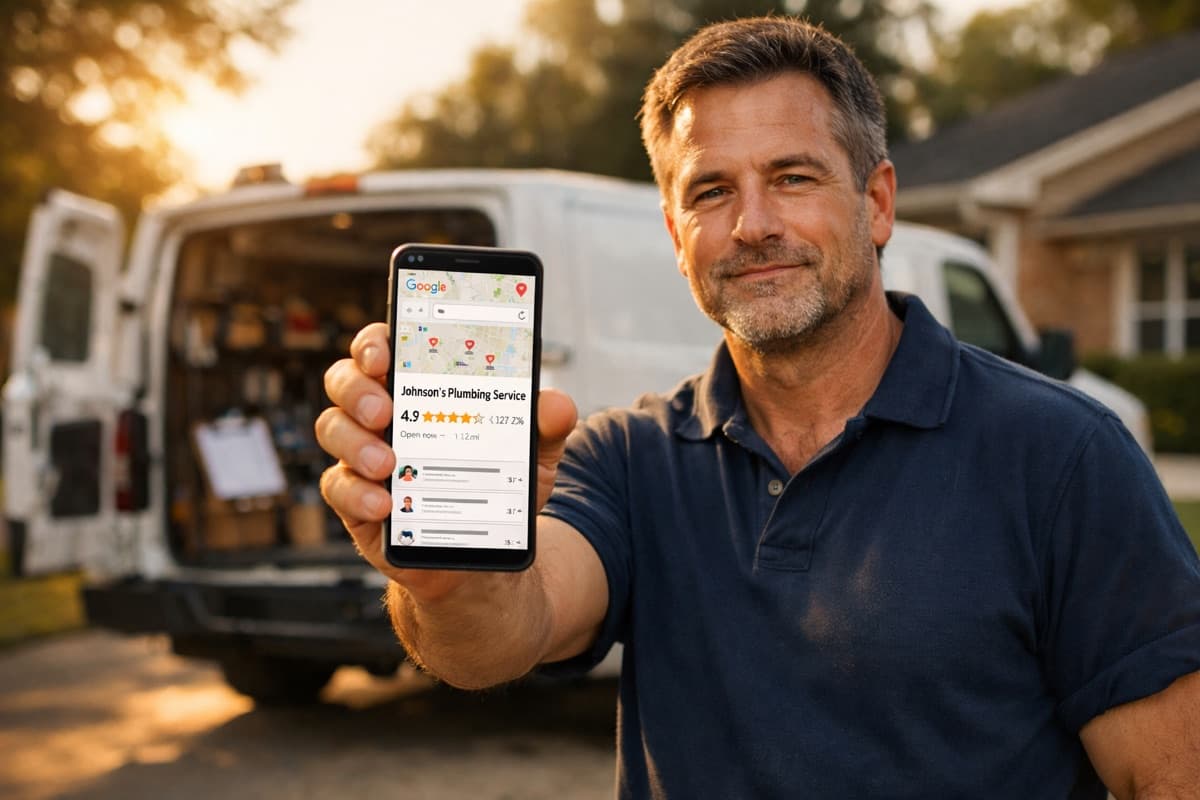
You searched "plumber near me" out of curiosity last month. Your company was nowhere in the top three. The first result had 247 reviews. The second had 189. The third had 94. You have 11.
None of those businesses are better than yours. You have been doing this work longer than some of them have been licensed. But Google does not know that. Google knows what it can measure: reviews, posts, photos, response times, category signals, and profile completeness. On every one of those dimensions, your competitors have been feeding the algorithm and you have not.
That is the gap this guide closes.
This is not a guide about getting lucky in local search. It is a systematic walkthrough of every lever on your Google Business Profile and exactly how to move each one. By the time you finish reading, you will know what is holding your profile back, what to fix first, and which of those fixes you can automate so they compound every week without you having to think about them.
---
Table of Contents
1. Why your Google Business Profile is the most important free marketing asset you have
2. The Map Pack: how the local 3-pack actually gets ranked
3. Setting up a profile that ranks versus one that just exists
4. The category trap: choosing primary and secondary categories that win
5. Photos that drive calls versus photos that just sit there
6. The review system that compounds: timing, asking, automating, and responding
7. Posts and updates: the weekly cadence that signals freshness to Google
8. Services and products: showing up for the right specific searches
9. Q&A: pre-answering the questions every customer asks
10. The messaging feature: turning your GBP into a live lead capture channel
11. Performance metrics: what to track and what to ignore
12. Common mistakes that tank GBP rankings
13. Industry specific playbooks: HVAC, plumbing, electrical, roofing, auto repair, and more
14. Connecting your GBP to your website and your automation system
15. The 30 day GBP optimization plan
---
Chapter 1: Why Your Google Business Profile Is the Most Important Free Marketing Asset You Have
Local service businesses spend money on truck wraps, yard signs, direct mail, and Facebook ads. All of those have their place. But none of them match the return on investment of a fully optimized Google Business Profile because none of them show up at the exact moment a person is searching for what you do.
The numbers make the case clearly. Roughly 46 percent of all Google searches have local intent. "HVAC repair near me," "plumber in [city]," "electrician open now" — those are searches from people who have already decided they need someone and are now choosing who to call. The business that appears in the top three results of the Map Pack captures somewhere between 44 and 61 percent of the clicks on those searches, depending on the service category.
The Map Pack — the three business listings that appear below the map and above the organic results — is not paid advertising. You cannot buy your way in. You earn that position through the strength of your profile, the volume and recency of your reviews, the completeness of your information, and the activity signals you send Google every week.
The platform is free. The leverage it provides a small service business is genuinely outsized relative to every other marketing channel available at zero cost. A fully optimized profile generates inbound calls, direction requests, and website visits from people who are already looking for exactly what you offer. You do not have to interrupt them. They came to find you.
The catch is that "claimed" and "optimized" are not the same thing. Most service businesses claimed their profile two or three years ago, filled in the basics, and then walked away. That profile exists. It is not working. This guide is about the difference between existing and working.
---
Chapter 2: The Map Pack — How the Local 3-Pack Actually Gets Ranked
Google uses three primary factors to determine which businesses appear in the Map Pack for any given search: relevance, distance, and prominence. Understanding all three tells you exactly where to put your energy.
Relevance is how well your profile matches what the searcher is looking for. This is driven by your primary category, your secondary categories, the services you have listed, the keywords in your business description, and the language that appears in your reviews. A plumbing company that has listed water heater installation as a service and has 30 reviews that mention "water heater" will rank better for "water heater installation near me" than a competitor with the same primary category but no service listings and no relevant review language.
Distance is the proximity of your listed business address or defined service area to the searcher's location. You cannot control this factor directly. What you can do is make sure your service area is accurately defined, your address is correct, and your business information is consistent everywhere Google might look for it.
Prominence is Google's measure of how well known and trusted your business appears to be based on signals it can collect: the number and average rating of your Google reviews, the number of links to your website from other sites, the completeness of your GBP profile, and the presence of your business name on other directories and review platforms. Prominence is the factor you have the most control over. It is also the factor most service businesses are doing the least to build.
What this means in practice: if two HVAC companies are the same distance from the searcher and have roughly equivalent categories, the one with 200 reviews and a complete profile beats the one with 15 reviews and a sparse profile almost every time. The review gap is not cosmetic. It is a ranking signal. The photo gap is not cosmetic. The post gap is not cosmetic. Every unfilled section of your GBP is a prominence signal you failed to send.
---
Chapter 3: Setting Up a Profile That Ranks Versus One That Just Exists
Before you optimize, you need a foundation that is airtight. A surprising number of service businesses have profiles with basic errors that are quietly suppressing their rankings.
Start with your NAP: name, address, phone number. These three pieces of information on your Google Business Profile must exactly match what appears on your website, your Facebook page, Yelp, Angi, the BBB, and every other place your business is listed online. Google cross-references these sources. When the information conflicts, it introduces uncertainty and can depress your ranking. A business listed as "ABC Plumbing LLC" on Google but "ABC Plumbing" on Yelp and "A.B.C. Plumbing" on a local directory has a consistency problem that costs it ranking points it did not know it was losing.
Next, verify whether you are configured as a storefront business or a service area business. If you go to customers rather than having them come to you — which describes nearly every trade business — you should be set up as a service area business. This configuration hides your home address if you work from home and allows you to define the geographic radius or list of cities you serve. Service area configuration matters for ranking. Google uses it to determine which searches are geographically relevant to your profile.
Your hours must be accurate and updated for holidays and seasonal changes. Google surfaces "open now" as a prominent filter option for searchers. A business whose profile says it is open but is actually closed creates a negative experience and a potential complaint. More importantly, inaccurate hours signal to Google that the profile is not actively maintained, which works against you in prominence scoring.
Your business description is 750 characters of prime real estate. Use it to describe what you do, who you serve, and what makes your business worth calling. Write naturally but include the service language your customers would use: "emergency drain cleaning," "same day water heater replacement," "licensed residential and commercial electrical work." Do not stuff it with repetitive keywords. Write for the human reader and the relevant terms will appear organically.
Your website link should point to your homepage or a relevant service page. If you do not have a website yet, this is a significant gap in your prominence signaling. A GBP without a website loses credibility signals it could be accumulating every day. Claim your free landing page here and connect it to your profile today — it takes less than an hour and closes one of the most common gaps in a service business profile.
---
Chapter 4: The Category Trap — Choosing Primary and Secondary Categories That Win
This is the single most common mistake that costs service businesses Map Pack visibility. It is also the easiest to fix once you understand what is happening.
Your primary category is the most powerful ranking signal on your profile. Google uses it to determine which searches your business is even eligible to appear in. If you set your primary category to "Contractor" when you should have set it to "Plumber," you will miss every search for "plumber near me" in your area. Not because of your reviews or your photos. Because Google does not classify you as a plumber.
The trap works like this: the business owner, trying to be accurate, picks a broad or literal category rather than the specific one Google uses for that trade.
Common examples of businesses that are miscategorized and do not know it:
An HVAC contractor who picked "Air Conditioning Contractor" when "HVAC Contractor" is the correct primary and carries more search volume. A plumber who picked "Plumbing Supply Store" instead of "Plumber." An electrician who picked "Contractor" instead of "Electrician." A roofer who picked "Roof Painter" instead of "Roofing Contractor." The fix is to search Google's exact category list and match it to how customers search, not how you think about your trade license.
Secondary categories expand your eligibility into adjacent searches. An HVAC company can hold "HVAC Contractor" as its primary category and add secondary categories for "Air Conditioning Repair Service," "Furnace Repair Service," "Heating Contractor," and "Boiler Supplier." Each secondary category gives the algorithm another set of search terms to match you against.
The practical rule: use as many secondary categories as accurately apply to your services. Google allows up to 10. Most service businesses use 1 or 2. The businesses dominating the Map Pack in competitive markets are frequently using 7 to 10 categories, all accurately matched to their actual service offerings.
If you are not sure whether your current category setup is costing you rankings, run a free audit at /audit — the diagnostic checks your primary category against what is ranking in your area and flags any gap it finds.
---
Chapter 5: Photos That Drive Calls Versus Photos That Just Sit There
Google's own published data shows that businesses with more than 100 photos on their GBP receive 520 percent more calls and 2,717 percent more direction requests than businesses with the median number of photos. Those numbers are dramatic enough to read twice.
The reason is not that Google rewards photo volume as a direct ranking factor, though freshness signals from recent photo uploads do contribute to activity scoring. The reason is that searchers comparing two plumbers in the Map Pack will click the profile whose photos show actual work: a completed water heater installation, a before and after on a drain job, a service truck in a recognizable neighborhood, a uniformed technician at a customer's door. The profile with stock images of a wrench or a clip art house communicates nothing real about the business. The profile with 60 job photos communicates competence, volume, and professionalism before a single word of marketing copy is read.
Here is what a photo strategy that drives calls actually includes:
Job photos. Before and after is the gold standard. A photo of a rusted, failing water heater next to the clean replacement you just installed is worth more than any description you could write. Two photos per job, taken on the job site, means 60 to 80 new photos per quarter if you are running steady volume. Make this a habit for every technician on your crew.
Team photos. A photo of your technicians in uniform, in front of a truck, or working a job tells the homeowner what to expect when your company shows up. It reduces friction. People hire people, not logos.
Truck and equipment photos. Marked vehicles are a trust signal. A fleet of two or three trucks, properly branded and photographed cleanly, communicates scale and professionalism at a glance.
Interior and shop photos (for businesses where customers come to you). Not critical for most trade businesses, but valuable for auto repair shops, HVAC showrooms, or any business where the customer visits your location.
What to avoid entirely: stock images, photos with watermarks, blurry phone shots taken in poor light, and anything that has not been updated in more than 12 months.
The consistency problem is that most business owners take photos in a burst when they first set up the profile and then stop. Three months later the photo gallery looks stale and the freshness signal degrades.
Photo cadence reminders. An automated weekly prompt to the owner or crew lead: "Did you take job photos this week? Add them to your GBP now." Some systems deliver this prompt automatically after a job closes, the same way a review request fires. The goal is fresh photos landing in your profile every week, not in a quarterly panic.
---
Chapter 6: The Review System That Compounds — Timing, Asking, Automating, and Responding
Reviews are the single highest-leverage element of your GBP optimization. They affect your Map Pack ranking through prominence signals, they affect your conversion rate when searchers read them, and they compound over time in a way that static content does not. A profile with 300 reviews that receives 5 new ones per week is building an asset that gets harder for competitors to catch up to every single month.
The timing problem is where most businesses fail. The optimal moment to ask for a review is within 24 hours of a completed job, when the customer's satisfaction is at its peak and the experience is fresh in their mind. Every day that passes reduces the response rate by roughly 20 to 30 percent. A week later, most customers have mentally moved on. Two weeks later, you are asking a cold contact to do you a favor they feel no particular motivation to do.
Most service businesses ask for reviews badly: in person at the end of the job, verbally, with no link, no guidance, and no follow-up. Even when the customer genuinely intends to leave a review, the friction of finding your Google listing, navigating to the review prompt, and writing something is enough to stop the majority of them.
The solution is a system, not a personal habit.
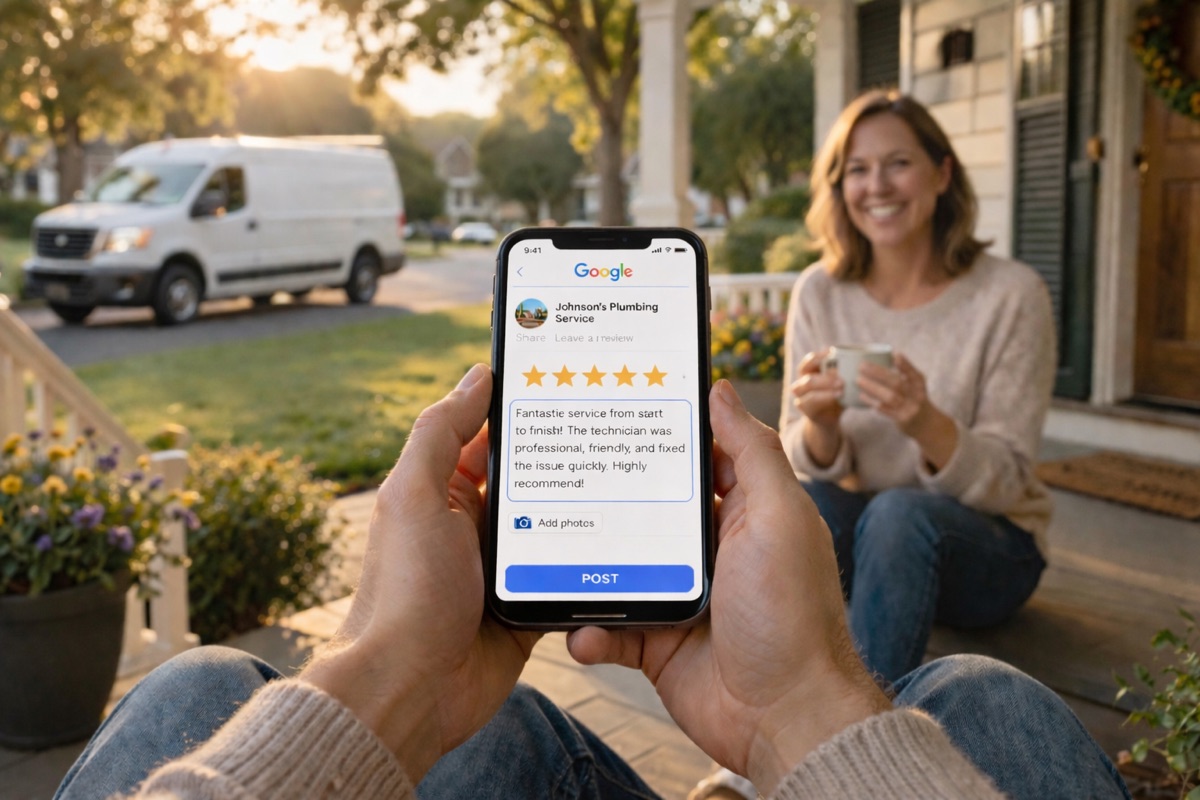
Review Booster. After every completed job, an automated SMS and email goes out to the customer within two hours of job close. The message is short and includes a direct link to your Google review prompt: "Hi [Name], thank you for choosing [Company] today. If you have a moment, we would love a Google review — it helps other homeowners find us when they need help. Here is your direct link: [link]." No friction. One tap to the review page. This single automation, deployed consistently, will multiply your review velocity within 30 days. The businesses in your market with 300 and 400 reviews are running some version of this system.
Review monitoring and alert. Every time a new review lands on your profile — 5 star, 1 star, or anything in between — you receive an immediate notification. You are not logging into Google manually every few days hoping something showed up. The alert comes to you the moment it posts.
Review response automation. For 5 star reviews, a templated thank-you response posts within minutes of the review landing. The response is personalized enough to not read as a bot reply, and it signals to future searchers that you are engaged with your customers. For 4 star reviews and below, the system flags the review for a human response and follows a structured escalation path. Responding to reviews is both a GBP ranking signal and a conversion signal for every future searcher who reads your profile.
Negative review intercept. This automation runs before the review gets posted. After a job closes, customers receive a brief satisfaction check: "How did we do today? Reply 1 for great, reply 2 if we could have done better." Customers who indicate any dissatisfaction are routed directly to a conversation with the owner or manager rather than to the public Google review page. Happy customers are routed to the review link. This dramatically reduces the number of 1 and 2 star reviews that reach Google and gives the business a chance to resolve problems privately before they become public.
A note on unfair or fake reviews: flag them through Google's review management tool immediately and document the flag. Do not respond with emotion. If the review describes a job you have no record of, your response is still read by every future customer who sees the exchange. Keep responses professional, factual, and brief. "We have no record of this service and would welcome the opportunity to speak with you directly at [phone number]" is more persuasive to future readers than a paragraph of defensiveness.
A service business running Review Booster consistently will typically see review velocity increase 3 to 5 times within 60 days. The compounding effect is real: 300 reviews with a 4.8 average rating is not just a ranking signal. It is a conversion asset that closes customers before they even pick up the phone.
---
Chapter 7: Posts and Updates — The Weekly Cadence That Signals Freshness to Google
Google Business Profile allows you to publish posts — updates, offers, events, and service highlights — that appear directly on your listing in the Map Pack and on your full profile page. Most service businesses never use this feature. The ones who do consistently hold a freshness advantage over competitors who do not.
Posts do not have a dramatic direct effect on ranking as a standalone signal. What they do is tell Google that your profile is actively managed. A profile with a post from 48 hours ago reads differently in Google's index than one where the last visible activity was 14 months ago. Combined with fresh photos and recent reviews, consistent posting is part of the activity stack that contributes to your overall prominence score.
What to post: completed jobs ("We just replaced a 22 year old furnace in [neighborhood] — here is what the homeowner had been living with"), seasonal service reminders ("AC tune-ups are booking fast for June — schedule yours now"), new service offerings, time limited promotions, team announcements, and local event connections where genuine. Posts with photos consistently outperform text-only posts for clicks and engagement.
The cadence that works: one post per week minimum. For most service businesses, two posts per week is achievable and noticeably better than one for freshness signaling.
The execution problem is universal. Business owners intend to post and do not. The week gets busy. Friday arrives. Nobody posted. Three months pass and nothing went out.
GBP post automation. A scheduled system drafts and queues one to two posts per week based on your services, the season, and your recent job completions. Posts can be reviewed and approved before they publish, or set to auto-publish on a defined schedule. The goal is not a perfectly crafted post every time. The goal is consistent activity. A good post published every week beats a great post published twice a year.
---
Chapter 8: Services and Products — Showing Up for the Right Specific Searches
The services section of your GBP is directly connected to how Google scores your relevance for specific search queries. When you list "water heater installation" as a service and a customer searches "water heater installation near me," your service listing creates a matching signal that supports your appearance in results for that search. Businesses that have not filled out their services section are functionally invisible for those long-tail searches, even if they do that work every day.
Every specific service you offer should appear in your services list. For a plumbing company, that means not just "plumbing" but water heater installation, water heater repair, drain cleaning, sewer line repair, toilet replacement, garbage disposal installation, tankless water heater installation, and every other distinct job you quote. Each is a search term. Each is an opportunity you are either claiming or leaving for a competitor.
Service descriptions matter. A one to two sentence description for each listed service that naturally includes how customers describe the problem — "24 hour emergency drain cleaning for residential and commercial properties, including main line clogs and grease buildup" — is meaningfully better than leaving the description field blank.
The products section is less commonly used by service businesses but carries real value for companies that sell specific equipment alongside installation: HVAC companies selling particular system brands, auto repair shops selling tires, plumbing companies selling water treatment systems. If you sell a definable product, list it with pricing when available. Pricing information on GBP reduces a common hesitation that otherwise kills calls before they start.
---
Chapter 9: Q&A — Pre-Answering the Questions Every Customer Asks
The Q&A section on your GBP allows anyone to ask a question about your business and anyone — including you — to answer it. Most service businesses leave this section empty and let it fill organically, which means when questions do arrive, they often go unanswered for weeks. Worse, when another user answers incorrectly, that wrong answer sits on your profile indefinitely.
The correct approach is to pre-populate Q&A yourself with the questions your customers ask every single week. Every business owner already knows what those questions are: "Do you offer same day service?", "Do you work on weekends?", "Do you give free estimates?", "Are your technicians licensed and insured?", "Do you charge a diagnostic fee?", "What areas do you serve?", "Do you accept credit cards?", "Do you offer financing?", "How quickly can you get to my home?"
Answer those questions yourself, from your business account, before any customer has to ask. This puts accurate, current information in your profile that searchers can read before they even call. It also closes the risk of someone else answering incorrectly and that answer becoming the first thing potential customers see.
Q&A pre-population. A one-time setup of 8 to 12 pre-answered questions using your actual business policies, service area, and pricing structure. After that, a monitoring system checks for new incoming questions and alerts the owner so nothing goes unanswered for more than 24 hours. Unanswered questions, or questions answered incorrectly by a third party, are a trust liability on an otherwise optimized profile.
---
Chapter 10: The Messaging Feature — Turning Your GBP Into a Live Lead Capture Channel
Google Business Profile includes a messaging feature that allows searchers to send a direct message to your business from the Map Pack without visiting your website or dialing your number. This is a live lead channel that most service businesses have never enabled.
The reason it matters: a meaningful segment of potential customers — particularly in the 25 to 40 age range — will not call a number they found in search results. They will message. If you do not have messaging active on your profile, those leads do not call someone else. They message someone else.
The reason most businesses do not use messaging effectively is response time. Google measures how quickly you respond to GBP messages. If your median response time exceeds a few hours, Google may downgrade or disable messaging on your profile. If a customer messages at 7 PM on a Tuesday and receives a reply Wednesday morning, they have already hired the contractor who answered in six minutes.
Messaging integration. GBP messages routed through an automation system receive the same immediate response treatment as a missed call text back. The moment a message arrives, an automated acknowledgment goes out within seconds: "Thanks for reaching out to [Company]. We received your message and will respond within the hour. For urgent issues, you can also reach us directly at [phone number]." Simultaneously, the business owner or dispatcher receives an alert and the full message text. Response times drop from hours to minutes. Leads stop disappearing.
If you are not sure whether your GBP messaging is active and how it connects to your overall lead response system, run the free diagnostic at /audit — it surfaces messaging gaps as part of the full profile check.
---
Chapter 11: Performance Metrics — What to Track and What to Ignore
Google Business Profile provides an insights dashboard with data on how your profile is performing. Most of it is useful. Some of it is noise. Here is how to sort them.
Track these:
Profile views. How many times your profile appeared in Google Search or Maps results. This is your top of funnel visibility number. If views are declining month over month (adjusting for seasonality), something in your ranking has shifted.
Search queries. The actual words people searched before your profile appeared. This tells you which services you are already being found for and which ones are completely missing from your visibility. If "furnace repair" drives 80 percent of your impressions but you also do AC installation and you are not showing up for it, your category or service listings need work.
Customer actions. The number of people who called your number from your GBP, requested directions, visited your website, or sent a message. These are your conversion metrics. A profile with high views but low calls tells you that people are seeing you but not choosing you — which points to a photo problem, a review volume problem, or a profile completeness gap.
Direction requests. A consistent upward trend in direction requests is a strong indicator of growing local awareness and profile strength.
Photo views. How often your photos are being viewed relative to your competitors in the same category. If this number is low, your photos are not competitive with what nearby businesses have posted.
Ignore these:
Month to month fluctuations in raw view counts without seasonal context. Search behavior in service trades is highly seasonal. Compare July to July, not July to June. Your raw "follower" count on any connected Google product. It has no meaningful connection to lead volume or revenue.
Performance reporting. A weekly automated digest delivered to your inbox every Monday morning with the numbers that matter: profile views, calls from GBP, direction requests, new reviews received, and photo view trends. No dashboard login required. No manual pulling of reports. The numbers appear in your inbox and you make decisions with them. This is the difference between data that sits in a tool and data that influences how you run your business.
---
Chapter 12: Common Mistakes That Tank GBP Rankings
These are the errors most frequently found in service business profiles that are stuck and cannot figure out why.
The wrong primary category. Covered in depth in Chapter 4, but worth stating again: this single mistake can exclude you from entire categories of relevant searches. Check your primary category before anything else.
Keyword stuffing in the business name field. Some businesses add descriptive keywords to their GBP business name — "ABC Plumbing | Emergency Drain Cleaning | Water Heater Repair." Google's guidelines explicitly prohibit this. Profiles caught doing it can be suspended entirely. Your listed business name must match your actual registered business name.
Inconsistent NAP across platforms. If your phone number on Google differs from the number on your website by even a single digit, or if your address format varies between platforms, the consistency signals that support your prominence score break down. Audit your major listings once per year at minimum.
No response to negative reviews. A 1 star review with no response is a worse conversion signal than a 1 star review with a calm, professional reply. Searchers read the response. They are evaluating how you handle problems, not just whether problems have occurred. One measured response to a negative review can flip the perception of a casual reader in your favor.
Service area misconfiguration. If you display a home address when you should be set up as a service area business, you create a trust issue for customers and a potential policy violation with Google. Businesses that do not receive customers at their listed address should not display that address publicly.
Outdated hours around holidays. Google surfaces "open now" as a prominent data point in the Map Pack. A business whose profile shows it is open on a holiday when it is closed will miss calls and collect frustrated reviews from people who drove to a locked door.
A dormant profile. No posts, no new photos, no new reviews for 90 days or more signals to Google's algorithm that the business may no longer be active. The algorithm does not reward dormant profiles with ranking gains. Consistent activity — even light activity — outperforms occasional bursts followed by silence.
---
Chapter 13: Industry-Specific Playbooks — HVAC, Plumbing, Electrical, Roofing, Auto Repair, and More
Every trade has a specific pattern of searches, a specific review timing window, and a specific set of categories that carry the most weight. Here is how to apply the full optimization framework by industry.
HVAC
Your primary category is "HVAC Contractor." Secondary categories should include "Air Conditioning Repair Service," "Furnace Repair Service," "Heating Contractor," and "Air Conditioning Contractor." Your services list must include heating installation, AC installation, furnace repair, AC repair, duct cleaning, indoor air quality testing, thermostat installation, and any other specific job you quote and book.
Review velocity is critical in HVAC because the jobs are high value — $2,000 to $12,000 for system replacements — and the purchase decision is high stress. A homeowner searching "HVAC company near me" in July when the AC has been out for two days is going to call the business with 200 reviews and a 4.8 rating, not the one with 8 reviews and no job photos. Review Booster deployed consistently after every completed job — not just system replacements, but tune-ups and service calls too — builds this review asset at a pace that compounds.
Photos in HVAC: document system replacements every time. The before photo of the old, failing equipment next to the after photo of the new system you installed is the most effective GBP photo format in the trade. Homeowners relate to it immediately and it communicates competence without a single word of copy.
Plumbing
Your primary category is "Plumber." Secondary categories should include "Drain Cleaning Service," "Emergency Plumber," "Water Heater Installation," and any commercial specialty category that applies.
Emergency plumbing calls are often won by whoever responds first, not by whoever is best. Messaging integration and missed call text back are particularly high value in plumbing because the customer is in acute distress and has no patience for a business that takes two hours to reply. A company that responds to a GBP message in under five minutes beats a company that calls back in three hours, every time. (For the full system that handles unanswered phone calls in addition to GBP messages, see our complete guide to missed call text back for service businesses. For the deeper review acceleration playbook, see our complete guide to getting more Google reviews.)
The review timing window for plumbing is especially short. Send the Review Booster request the same day, ideally within two hours of job close. By the next morning, the urgency has faded and the response rate drops significantly.
Electrical
Primary category: "Electrician." Secondary categories: "Electrical Installation Service," "Emergency Electrician," "Lighting Contractor," "Commercial Electrician" if you do commercial work.
Electrical work carries a trust dimension that many other trades do not. The customer is allowing you into their electrical panel and potentially into their walls. Photos of completed panel upgrades, EV charger installations, and generator hookups build trust before the call is made. Including photos of your license and any relevant certifications — where the platform allows it — closes a hesitation that some customers carry.
Service listings must be granular: panel replacement, circuit breaker installation, outlet installation, EV charger installation, generator installation, smoke detector installation, whole home rewiring, outdoor lighting installation. Each is a distinct search. Each is traffic you are either capturing or missing.
Roofing
Primary category: "Roofing Contractor." Secondary categories: "Roof Repair Service," "Gutter Cleaning Service," "Siding Contractor" if applicable, "Roof Inspection Service."
Roofing is heavily seasonal and storm driven. After a major weather event, search volume for roofing contractors spikes dramatically and competition for Map Pack visibility intensifies in days rather than weeks. Businesses that have consistently built their review base before storm season arrives have a structural advantage in those high-volume search windows that businesses starting from zero cannot close quickly.
After a significant weather event, GBP post automation should immediately publish a post acknowledging the storm and offering inspection services: "We are scheduling free storm damage inspections in [city] — contact us today to get on the calendar." Speed matters. A post published within 24 hours of a major hail or wind event captures search traffic while it peaks. A post published four days later catches the tail end.
Auto Repair
Primary category: "Auto Repair Shop." Secondary categories: "Oil Change Service," "Brake Shop," "Tire Shop," "Transmission Shop," "Auto Electrical Service" — matched to your actual specialties, not a wishlist.
Auto repair benefits from a longer customer relationship than most trades. A customer who gets their oil changed four times a year and comes in for brakes and tires is worth $800 to $1,500 annually over a multi-year relationship. Post-job check in and past-customer reactivation automations are particularly valuable in auto repair. A seasonal reminder — "Winter is coming — is your battery and coolant ready? Book a free pre-winter inspection at [Company]" — drives repeat visits from customers who already trust you without requiring you to acquire a new customer from scratch.
Reviews in auto repair often contain specific service mentions. "They were great at diagnosing my transmission problem" is a relevance signal for transmission repair searches. Review Booster requests in auto repair should be slightly personalized to the job completed, which prompts more specific and useful review language.
Landscaping, Cleaning, Pest Control, and Other Trades
The same framework applies across every service trade. The principles are consistent: correct primary category, accurate secondary categories, granular service listings, job photo documentation, consistent review velocity through automation, and the activity stack that keeps the profile signaling to Google every week without requiring daily manual attention.
If you have not recently audited your profile against these criteria across your industry, start with the free profile diagnostic at /audit — it runs a complete check and maps every gap to a specific fix.
---
Chapter 14: Connecting Your GBP to Your Website and Your Automation System
Your GBP and your website are not two separate marketing assets. They are two components of the same signal system. When they work together, they amplify each other's authority. When they are disconnected or inconsistent, neither performs as well as it should.
Google uses your website to confirm and expand the relevance signals on your GBP. If your website has a dedicated page for water heater installation with real descriptive content, and your GBP lists water heater installation as a service, those two signals reinforce each other in Google's index. If your GBP lists a service that has no corresponding page or mention on your website, one of those signals is floating without support.
Your website URL on your GBP should point to your homepage, but the experience a visitor has when they land there matters more than most business owners realize. A website that takes 8 seconds to load on mobile, fails a basic core web vitals check, or has no clear way to call or request a quote is converting a fraction of the GBP traffic it receives. Google tracks user behavior after the click. A pattern of visitors clicking from your GBP and immediately bouncing is a negative signal.
If your website may be underperforming, you do not have to guess. Run the free website audit at /audit — it performs a real Lighthouse diagnostic and returns specific numbers: load time, mobile performance score, core web vitals, and the precise issues suppressing your conversion rate and your organic ranking. It then maps those findings to the MustHavesAI modules that would close each gap.
The automation system connection is the piece that ties the entire GBP strategy together into something that compounds without constant manual input.
Review Booster fires after every job close because it is connected to the job management signal from your system. It runs without anyone pressing a button.
GBP post automation runs on a schedule because it is connected to your content calendar and your seasonal service list. The posts go out weekly whether or not you remembered to log in.
Messaging integration works around the clock because your GBP messages route through the same response system that handles your missed calls — immediate acknowledgment, owner alert, and a structured follow-up path.
Performance reporting consolidates your GBP insights, website traffic, and review metrics into one weekly digest that arrives in your inbox without any manual report pulling.
This is the difference between maintaining a GBP profile and running a GBP as a compounding business asset. One requires your attention every week. The other builds your ranking and your review base while you are on a job.
---
Chapter 15: The 30 Day GBP Optimization Plan
If you have read this far, you have the full picture. What follows is the execution sequence. Thirty days is enough time to move the needle measurably if you work in order and do not skip the foundation steps.
Days 1 to 3: Foundation audit and repair
Start with every element in Chapter 3 and Chapter 4. Verify your NAP is consistent across your website, GBP, Yelp, and any other major directory where your business appears. Confirm your primary category and fix it if it is wrong. Add secondary categories up to 10, matched to your actual services. Update your hours. Rewrite your business description if it is generic or empty. Add your website URL if it is missing. Configure your profile as a service area business if you are not already set up that way.
This takes two to four hours of focused work. It is the work most people skip, which is precisely why doing it creates separation.
Days 4 to 7: Services, Q&A, and photos
Fill out the services section completely. Every distinct job you quote should be a listed service with a one to two sentence description. Populate the Q&A section with 8 to 12 pre-answered questions using the questions you get every week from customers on the phone. Add 20 photos minimum: before and after job shots, team photos, truck photos. If you do not have 20 quality job photos ready today, take them on your next 10 jobs and upload immediately. Do not wait until you have 50.
Days 8 to 14: Reviews
Deploy Review Booster. If you are not using an automation system yet, start by sending review requests manually to every customer from the last 60 days for whom you have a phone number. Reach out personally: "We worked on your [service] recently — if you have a moment, a Google review would genuinely help us. Here is the direct link." This manual effort gives you a base while the automation takes over for every job going forward.
Respond to every existing review on your profile that does not yet have a response, regardless of star rating. Google surfaces your response rate as a visible profile attribute. Searchers notice the gap between a business that responds to nothing and one that responds to everything.
Days 15 to 21: Posts, messaging, and Q&A monitoring
Set up GBP post automation or, if you are managing this manually for now, draft and schedule four posts for the next four weeks, one per week. Turn on GBP messaging if it is not active. Configure messaging integration so incoming messages receive an immediate automated acknowledgment and a simultaneous owner alert.
Days 22 to 30: Measurement and iteration
Check your GBP insights. What search queries brought up your profile? Which services are you not being found for at all? Are calls from the Map Pack trending upward? Are photo views increasing? Use this data to decide what to prioritize in month two: additional service listings, a seasonal post series, doubling down on review velocity, or fixing photo gaps in a specific service area.
By day 30, your profile should be measurably more complete, your review count should be moving, and your Map Pack visibility should be improving for searches where you were previously invisible. The automations you deploy in this window continue to compound after day 30 without additional effort. That is the point of building a system instead of completing a sprint.
---
The Company That Shows Up Consistently Wins
Your competitors who dominate the Map Pack are not more talented than you. They are not more experienced or better capitalized. In most cases, they have simply maintained a more complete and more active Google Business Profile for longer than you have. They started the system earlier, and the system has been compounding ever since.
The gap between where you are now and where they are is closable. The levers are visible. The work is specific. And the automations that keep the profile building — Review Booster, GBP post automation, messaging integration, photo cadence reminders, performance reporting — are things you can put in place once and let run while you focus on the work you are actually in business to do.
What you cannot do is wait. Every week without a review request going out is a week of review velocity you did not build. Every week without a post is a week of freshness signal you did not send. Every GBP message that sits for four hours is a lead that left for the competitor who replied in two minutes.
The businesses that look like they are everywhere in local search — the ones with 400 reviews, consistent posts, and a full photo gallery that gets updated constantly — did not build that overnight. They built it because they started earlier and let the system run. Start now, and the compounding works in your favor from here.
Already have a website? Get Your Free Website Audit
No website yet? Claim Your Free Landing Page